
Saplings continue to thrive at the ecological restoration experimental area in Landing, Mounts Iglit-Baco Natural Park

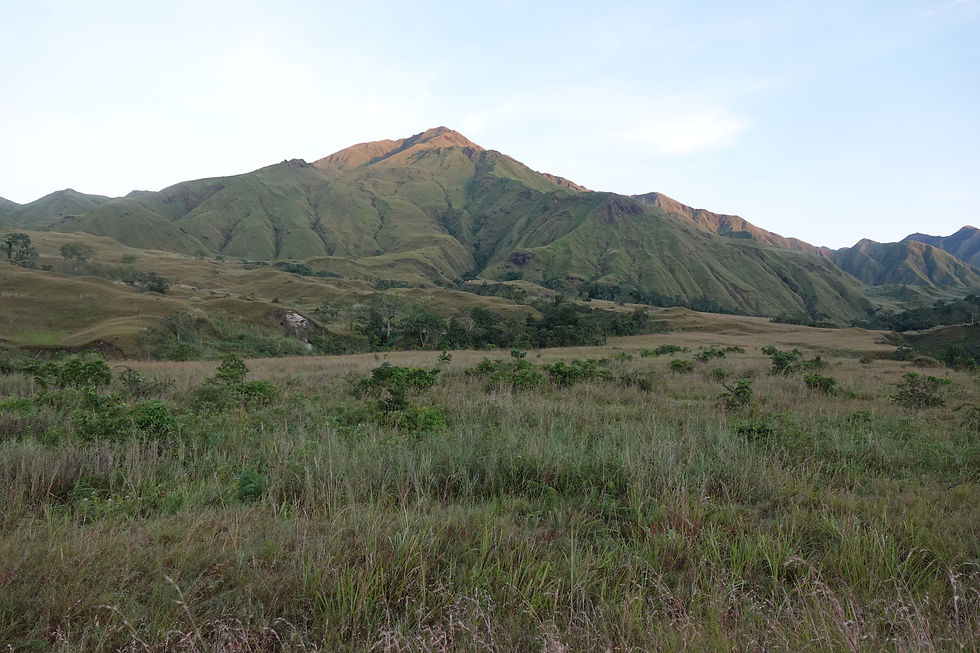
The biannual monitoring conducted on December 10, 2025 of saplings in both the “with-intervention” island mounds (size of area: two hectares) and “no-intervention area” (size of area: 2 hectares) in Landing, revealed that saplings in the former grew by an average of 8.2 cm. (smallest: 10 cm; tallest: 258 cm; n= 949) from the last monitoring in July 2025 (smallest: 10 cm; highest: 225 cm: n = 964). The root collar diameters (RCD) of saplings with heights greater than 1 meter were measured for the first time, now that many of the young trees have heights greater than 1 meter. The average RCD was 4.72 cm (n = 572). There were more than 80 species of saplings in the “with-intervention” island mounds that survived at Landing; more than 30% of these were brought to the area by natural dispersion. The seedlings were mainly collected from the vicinity of Station 2. The experimental area in Landing was established in the second part of 2022.
The average height of the naturally growing seedlings in the quadrats in the "no-intervention" area has not reached 1 meter yet (average height - 97.45 cm; n - 61; number of species - 10; smallest - 10 cm; highest - 200 cm). This seems to show that many of the seedlings in this area do not survive one annual cycle.
Basic permaculture-based techniques were applied in the “with-intervention” island mounds. The core of these interventions is the addition of biomass (decaying logs and leaves gathered nearby) during the establishment of the mounds, and the regular addition of biomass. Other techniques include mulching, ringweeding, creation of swales to trap water, and allowing naturally growing bushes to grow alongside the seedlings to control temperature. A fireline was established to protect the area from fires that occur during the long dry season (January to May).
The findings and lessons from this experimental area will be applied in other similarly situated areas of the park.
This work is part of Thriving Together with Tamaraw, a consortium led by Re:wild, in partnership with the D'ABOVILLE Foundation and Demo Farm, Inc. (DAF), and the Mindoro Biodiversity Conservation Foundation, Inc. (MBCFI), with support from the Biodiversity Challenge Funds (BCF) through UK Aid.




Comments